Department of History
North Bengal University
New Syllabus 2022
Semester | Course code | Course title | Course Type | Course credit | Total |
1st Semester | HIS-CT-101 A | Ancient Indian History: Pre-and Protohistory and Early Historic Period |
Core Paper-1 | 2 | 4 |
HIS-CT-101 B | 2 |
HIS-CT-102 A | TheRiseofIslamin India: Contestations and Negotiations |
Core Paper-2 | 2 | 4 |
HIS-CT-102 B | 2 |
HIS-CT-103 A | History of Modern India (1757A.D. 1858A.D. |
Core Paper-3 | 2 | 4 |
HIS-CT-103 B | 2 |
HIS-ET-104 | Gender andWomen in Early India | DSE-1 | 2
| 2 |
HIS-ET-105 | Environmental and Ecological Consciousness in Ancient India | DSE-2 | 2 | 2 |
HIS-ET-106 | Gender andWomen in Medieval India | DSE-3 | 2 | 2 |
HIS-ET-107 | Man, Environment and Ecology in Medieval India | DSE-4 | 2 | 2 |
HIS-ET-108 | Women in Colonial India | DSE-5 | 2 | 2 |
HIS-ET-109 | History of Ecology and Environment in Modern India | DSE-6 | 2 | 2 |
|
2nd Semester | HIS-CT-201 A | Ancient Indian History: Historical Period, 300-1200 CE | Core-1 | 2 | 4 |
HIS-CT-201 B | 2 |
HIS-CT-202 A | Medieval India: 1200-1800CE:State, Economy, and Society o fMedieval India | Core-2 | 2 | 4 |
HIS-CT-202 B | 2 |
HIS-CT-203 A | History of Modern and Contemporay India (1858-1971) | Core-3 | 2 | 4 |
HIS-CT-2 03B | 2 |
HIS-ET-204 | History of Science and Technology in Ancient India | DSE-7 | 2 |
|
HIS-ET-205 | Maritime History of Ancient India | DSE-8 | 2 |
|
HIS-ET-206 | History of Science and Technology in Medieval India | DSE-9 | 2 |
|
HIS-ET-207 | Maritime History of Medieval India | DSE-10 | 2 |
|
HIS-ET-208 | History of Science, Technology and Medicine in Colonial India | DSE-11 | 2 |
|
HIS-ET-209 | History of Indian Diaspora | DSE-12 | 2 |
|
| Study of Cultural Heritage and Archives (Activity Based Papers) |
| 2 |
|
| Study Tour and Project (Activity Based Papers) |
| 2 |
|
|
3rd semester | HIS-CT-301 A | State in India | Core-1 | 2 | 4 |
HIS-CT-301 B | 2 |
HIS-ET-302 | Ancient Societies: Egypt, Mesopotamia, Greece,Rome,and China | DSE-13 | 2 | 2 |
HIS-ET-303 | Sculptural Art of Ancient andEarly Medieval India | DSE-14 | 2 | 2 |
HIS-ET-304 | Ancient andEarly Medieval Architecture of India | DSE-15 | 2 | 2 |
HIS-ET-305 | Methods, Thoughts, and Practice of Archaeology | DSE-16 | 2 | 2 |
HIS-ET-306 | Medieval Art and Architecture of India | DSE-17 | 2 | 2 |
HIS-ET-307 | Socio Religious Movements in Medieval India | DSE-18 | 2 | 2 |
HIS-ET-308 | History of Medieval Bengal | DSE-19 | 2 | 2 |
HIS-ET-309 | Growth of Urban Spaces and Urbanism in Medieval India | DSE-20 | 2 | 2 |
HIS-ET-310 | Economic History of Colonial India, 1757-1857 | DSE-21 | 2 | 2 |
HIS-ET-311 | Economic History ofColonial India1857-1947 | DSE-22 | 2 | 2 |
HIS-ET-312 | Tribal History of India | DSE-23 | 2 | 2 |
HIS-ET-313 | HistoryofModern Bengal (1757A.D.– 1947 A.D.) | DSE-24 | 2 | 2 |
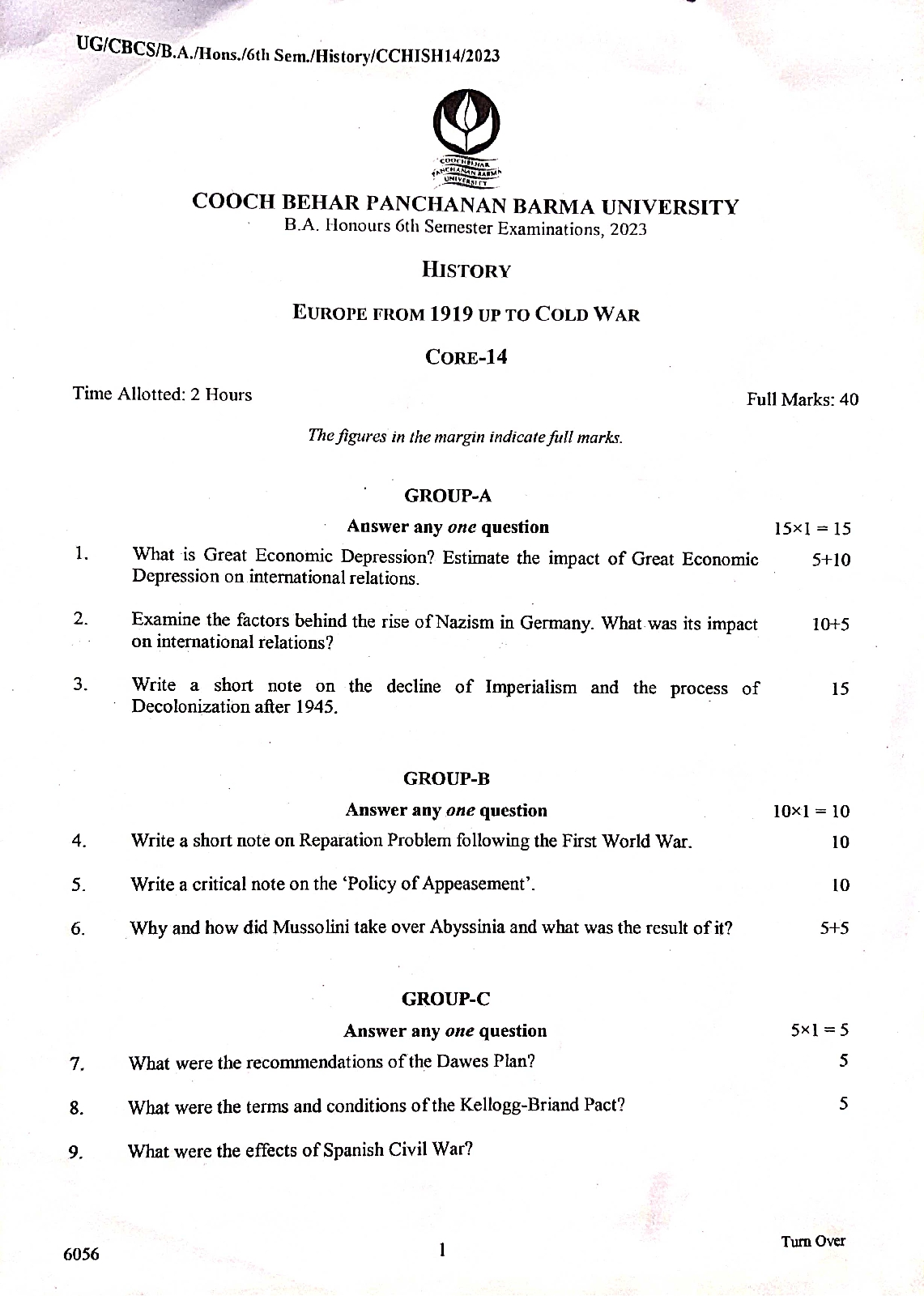
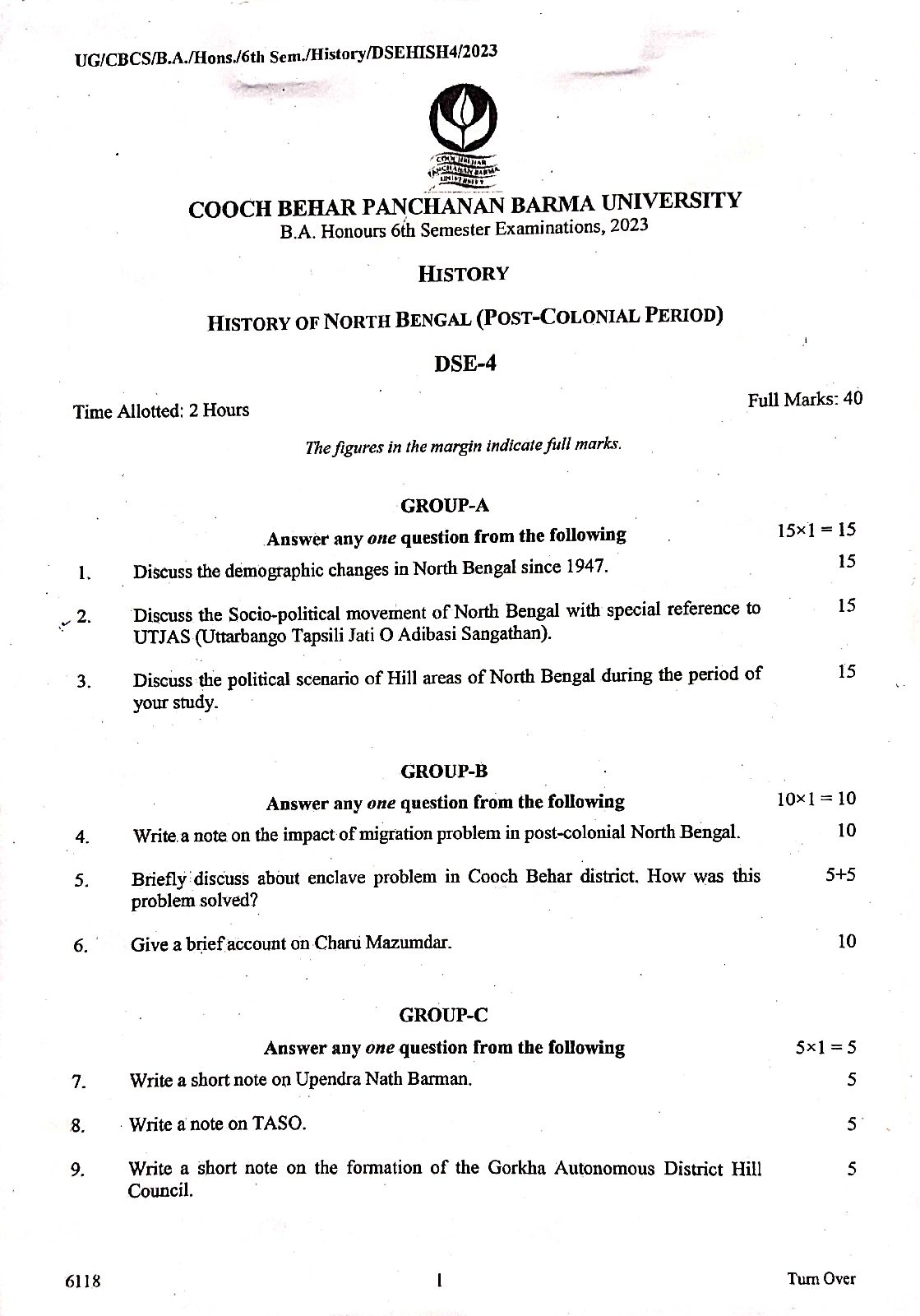
HIS-GE-31 4A | History of North Bengal | GE | 2 | 4 |
HIS-GE-31 4B: | 2 |
|
4th semester | HIS-CT-401 A | Historiograpy: Concepts, Methods, and Tools Colonialism And The Emergence Of New Political Ideas | Core-1 | 2 | 4 |
HIS-CT-401 B | 2 |
HIS-CT-402 A | Colonialism And The Emergence Of New Political Ideas | Core-2 | 2 | 4 |
HIS-CT-402 B | 2 |
HIS-ET-403 | History of Epidemics, Illness, Health, and Medicine in Ancient India | DSE-25 | 2 | 4 |
HIS-ET-404 | History ofAncient Bengal | DSE-25 | 2 | 2 |
HIS-ET-405 | History of Health and Medicine in Medieval India | DSE-25 | 2 | 2 |
HIS-ET-406 | Literary Traditions and Architecture of Medieval Bengal | DSE-25 | 2 | 2 |
HIS-ET-407 | Colonial Power and Culture | DSE-25 | 2 | 2 |
HIS-ET-408 | Violence and Repression | DSE-25 | 2 | 2 |
HIS-GE-40 9A | Sources and Themes in Indian History | GE | 2 | 4 |
HIS-GE-4 09B | 2
|
1st Semester
Core: CT-101 (75+25=100), CT-102 (75+25=100) & CT-103 (75+25=100), Each paper is divided into two halves
DSE: Ancient: ET-104, ET-105, Medieval: ET-106, ET-107, Modern: ET-108, ET-109 (40+10= 50)
Students, according to their specialization, have to choose one paper from the basket of DSE Papers AEC= 50 marks
Internal Assessment: Total: 400, Total Credit- 16, Total lecturers in week |
Core Papers
Course: HIS-CT-101A & HIS-CT-101B- Ancient Indian History: Pre-and Protohistory and Early Historic Period
Course: HIS-CT-102A & HIS-CT-102B: The Rise of Islam in India: Contestations and Negotiations
Course: HIS-CT-103A & HIS-CT-103B: History of Modern India (1757A.D.1858A.D.
DSE Papers
Ancient:
Course: HIS-ET-104: Gender and Women in Early India
Course: HIS-ET-105: Environmental and Ecological Consciousness in Ancient India
Medieval :
Course: HIS-ET-106: Gender and Women in Medieval India
Course: HIS-ET-107: Man, Environment and Ecology in Medieval India
Modern:
Course: HIS-ET-108: Women in Colonial India
Course: HIS-ET-109: History of Ecology and Environment in Modern India
2nd Semester
Core: CT-201 (75+25=100), CT-202 (75+25=100) & CT-203 (75+25=100), Each paper is divided into two halves
DSE: Ancient: ET-204, ET-205, Medieval: ET-206, ET-207, Modern: ET-208, ET-209 (40+10= 50), ACTIVITY BASED PAPERS FOR SECOND SEMESTER: 50 Students, according to their specialization, have to choose one paper from the basket of DSE Papers
SEC: 50 marks Internal Assessment: Total: 400, Total Credit- 16, Total lecturers in week |
Core Papers
Course: HIS-CT-201A & HIS-CT-201B: Ancient Indian History: Historical Period, 300-1200 CE
Course: HIS-CT-202A & HIS-CT-202B: Medieval India: 1200-1800 CE: State, Economy, and Society of Medieval India
Course: HIS-CT-203A & HIS-CT-203B: History of Modern and Contemporary India (1858-1971)
DSE Papers
Ancient:
Course: HIS-ET-204: History of Science and Technology in Ancient India
Course: HIS-ET-205: Maritime History of Ancient India
Medieval :
Course: HIS-ET-206: History of Science and Technology in Medieval India
Course: HIS-ET-207: Maritime History of Medieval India
Modern:
Course: HIS-ET-208: History of Science, Technology and Medicine in Colonial India
Course: HIS-ET-209: History of Indian Diaspora
Activity Based Papers For Second Semester
Option 1:
Course: ………………….: Study of Cultural Heritage and Archives
Option 2:
Course : ……………………. : Study Tour and Project
3rd semester
Core: CT-301 (75+25=100), The paper is divided into two halves
DSE: Ancient: ET-302 (40+10= 50), ET-303(40+10=50), ET-304 (40+10= 50), ET-305(40+10= 50) Medieval: ET-306(40+10= 50), ET-307(40+10= 50), ET-308 (40+10= 50), ET-309(40+10= 50) Modern: ET-310(40+10= 50), ET-311(40+10= 50), ET-312(40+10= 50), ET-313(40+10= 50), Students, according to their specialization, have to choose three papers from the basket of DSE Papers
GE: GE-314: (75+25=100) The paper is divided into two halves AEC: 50 Internal Assessment: Total: 400, Total Credit- 16, Total lecturers in week |
Core papers
Course: HIS-CT-301A & HIS-CT-301B: STATE IN INDIA
DSE PAPERS
Ancient:
Course: HIS-ET-302: Ancient Societies: Egypt, Mesopotamia, Greece, Rome, and China
Course: HIS-ET-303: Sculptural Art of Ancient and Early Medieval India
Course: HIS-ET-304: Ancient and Early Medieval Architecture of India
Course: HIS-ET-305: Methods, Thoughts, and Practice of Archaeology
Medieval :
Course: HIS-ET-306: Medieval Art and Architecture of India
Course: HIS-ET-307: Socio Religious Movements in Medieval India
Course: HIS-ET-308: History of Medieval Bengal
Course: HIS-ET-309: Growth of Urban Spaces and Urbanism in Medieval India
Modern :
Course: HIS-ET-310: Economic History of Colonial India, 1757-1857
Course: HIS-ET-311: Economic History of Colonial India , 1857-1947
Course: HIS-ET-312: Tribal History of India
Course: HIS-ET-313: History of Modern Bengal (1757 A.D. – 1947 A.D.)
GE Course
Course: HIS-GE-314A & HIS-GE-314B: History of North Bengal
1st Semester
Core Papers
Ancient
Paper Name: Ancient Indian History: Pre-And Proto-History And Early Historic Period Credit - 4
Paper Code: HIS-CT-101A & HIS-CT-101B
HIS-CT-101A:
Unit 1 | Palaeolithic Evidence: Definition, Scope, Terminology and Periodization; Hominid Fossils, Earliest Stone Tools, India in the Current Scheme of Human Evolution; Palaeolithic Sites, Sequences and Materials; Epi-Palaeolithic-Mesolithic Transition. |
Unit 2 | The Mesolithic Evidence: Microliths in the Pleistocene Bracket,Early Holocene Adaptations: Microliths Associated with the Evidence of Animal Domestication, Excavated Early Mesolithic Sites with Habitational Evidence; the Mesolithic Survivors (Continuity of Microliths Using Traditions),Rock Art of the Mesolithic Period. |
Unit 3 | Problem of the Beginning of Food Production in India and the Evidence from Mehrgarh, the Growth of Villages from Baluchistan to Western Uttar Pradesh |
Unit 4 | Origin, Terminology and Chronology of the Harappan Civilization,Distribution and Morphological Features of Mature Harappan Settlements, Aspects of the Harappan Civilization: Agriculture and Animal Husbandry, Internal and External Trades,etc. Harappan Art; Decline of the Harappan Urban Centres; Late Harappan Phase and Legacy of the Harappan Civilization. |
Unit 5 | Neolithic-Chalcolithic Cultures Outside the Harappan Orbit: Terminology, Distribution and Features; Early Use of Iron; Mature Phase of the Use of Iron and Associated Debates. |
HIS-CT-101B: Early Historical Period
Core 6 | Vedic Text sand Their Chronology; Early and Later Vedic Economy and Society; the Aryan Problem: Archaeological, Philological and Anthropological evidence |
Core 7 | The foundations of Early Historic India:Debates Associated with Northern Black Polished Ware (NBPW); Date of Buddha, Emergence of the Sixteen Mahajanapadas (Based on the Evidence of Buddhist, Jaina and Later Vedic Literatures), Identifications of These Geo-Political Orbits, Debates Pertaining to the ‘Second Urbanization’; the Rise of Magadha. |
Core 8 | Region-Wise Survey of Early Historical Sites-Urban Centres/Cities; Cultural and Trading Units, etc. |
Core 9 | Major Sources for the Historical Reconstruction of the Mauryan Period: Kautilya’s Arthasastra, Megasthenes’ Account (Indica), Inscriptions of Asoka (Major and Minor Rock Edicts and Pillar Edicts), Archaeological and Numismatic Evidence; Nature and Structure of the Mauryan Empire; Asoka and Buddhism, Asoka’s Dhamma, Mauryan Art and Architecture; Decline of the Mauryan Empire. |
Core 10 | The dynastic history of the subcontinent during c. 200BCE–300CE: the Sungas, the Indo-Greeks, the Saka-Pahlavas or Scytho-Parthians, the Satavahanas, the Saka-Ksatrapas, the Kusanas, the Cheras, the Cholas, the Pandyas; Archaeological Evidence:Settlements/Villages and Cities of the North-West, the Indo-Gangetic Divide and the Upper Ganga Valley, the Middle and the Lower Ganga Valley and Eastern India,Central and Western India, the Deccan and the Southern India;Nature of Polity,Crafts and Guilds,Traders and Trading Networks (Internal and External);Philosophical and Religious Developments (the worship of Yaksas, Yaksis, Nagas, Nagis; Vedic Rituals, Saivism, Emergence ofVaisnava Doctrine; the Emergence of Mahayana Buddhism, the Digambara-Svetambara Concept in Jainism). |
Medieval
Paper Name: The Rise of Islam in India: Contestations and Negotiations Credit - 4
Paper Code: HIS-CT-102A & HIS-CT-102B
HIS-CT-102 A: Sources and the Sultanate Period
Unit 1 | Survey of Sources in Medieval Indian History: Historical Writings, Contemporary Texts, Travelogues, Indigenous Literatures, Archaeological Sources. |
Unit 2 | Historiographical Debates Regarding ‘Transitions’ to the Sultanate Period. |
Unit 3 | Foundation and Consolidation of the Delhi Sultanate: Early Muslim Invasions,Coming of the Turks,Mahmud of Ghazni,Muhammad of Ghur, Qutbuddin Aibak, Iltutmish, Raziyya Sultan, Balban, the Khiljis, the Tughlaqs,Timur’s Invasion, the Sayyids and Lodis,Rise of Regional States with Special Reference to the Bengal Sultanate; Decline of the Delhi Sultanate; State and Society under the Delhi Sultanate |
Unit 4 | The Kingdom of Vijayanagar: Central and Provincial Administrations, Land Revenue, Army, Society. |
Unit 5 | The Bahmani Kingdom and the Deccani Sultanates: Administrative Parametersof the Bahmani State; the Bahmani Successors: the Nizam Shahis of Ahmednagar, the Imad Shahis of Berar, the Adil Shahis of Bijapur, the Qutb Shahis of Golconda, the Barid Shahis of Bidar |
HIS-CT-102 B: The Mughal Period and the Eighteenth Century
Core 6 | The Mughal Empire: Establishment of Mughal Rule: Babur’s Accession to the Throne, His Central Asian Connection, Humayun and Sher Shah Sur Interlude |
Core 7 | Political Achievement, Administrative and Religious Policies of Akbar; His Successors: Jahangir, Shah Jahan, Aurangzeb. |
Core 8 | Mughal Administration, Central and Provincial; Land Revenue, the Army, the Judiciary; Decline of the Mughal Empire. |
Core 9 | 18th Century Debate. |
Core 10 | Ascent of the Marathas under Shivaji; Rise of the Peshwas, Emergence of the Regional States: Punjab, the Jats, the Rajputs, Awadh, Bengal, Bihar and Odisha, Rohilkhand, Hyderabad, Karnataka, Mysore, etc |
Modern Paper
Name: Modern India: (History of Modern India (1757A.D. – 1858A.D.) Credit - 4
Paper Code: HIS-CT-103A & HIS-CT-103B
HIS-CT-103 A
Unit 1 | Understanding Modern India:Sources: Archival Records,Private Papers, Newspapers and Memoirs, Periodicals and Oral Tradition, Approaches and Interpretation – Different Schools of Thought |
Unit 2 | Historiography of 18th Century |
Unit 3 | British Expansion : 1. The British conquest of India: the Imperial World; Policy of Britain, War and Conquest, Native and Princely States from Hastings to Dalhousie, The Major Relations with Indian Native States – Sikhs, Mysore, Maratha and Other 2. India under the Governor-General Canning to Governor-General Lord Minto II 3. Principles and Policies Governing Foreign Relations 4. India and its Neighbours: Afghanistan, (ii) Tibet, (iii) Nepal, (iv) Burma and (v) Bhutan |
Unit 4 | Economy 1. New Types of Changes in Village Economy: Pre-ColonialLand Revenue Administrative: Eastern India, South India, Western India, Central And Northern India, Princely States; Land Market And Agricultural Prices; Peasants, Landlords, Agricultural Labour and Institutions of Finance, Rural Indebtedness 2. Types of Land Revenue Settlements , Agricultural Output, Levels and Brands and Natural and Regional Explanations 3. Commercialization of Agriculture: Indigo, Opium and Cotton: Eastern, Western, Central, Northern South India 4. Urban Economy: Decline of Town Handicrafts, HistoricalSignificance of the Decline, Rise and Development of Modern Industries, Emergence of Trusts and Monopolies, Finance Capital, Market, and Labour in Large Scale Industry 5.Artisans and Industrial Production; Debate Over De-Industrialization Regional Variations; Rise of Internal Markets and Urban Centres and Communications: Post, Telegraphs, Railways, Roads and Water Transport 6. Trade and Commerce: Changing External Trade, Indigenous Banking |
HIS-CT-103B
Unit 1 | Colonial Construction of India: a. Changing Framework of Colonial Governance & Administrative Structure, Regulating Act to Queen’s Proclamation 1858 b. The Arms of the State Police, Army, Law c. Ideologies of the Raj and Racial Attitude |
Unit 2 | Collaboration and Resistance: a. Muslims in the Armies, b. Peasant and Popular Resistance c. The Great Revolt of 1857 |
Unit 3 | Social and religious Reforms a. Missionaries b. Social reformers -Young Bengal Movement, Brahmo Samaj, Prarthana Samaj, Arya Samaj, Ishwar Chandra Vidyasagar, Veeresalingam Pantulu. |
DSE Courses
Ancient:
DSE-1
Paper Name: Gender and Women in Early India Credit - 2
Paper Code: HIS-ET-104
Unit 1 | Historical Analysis and the Indian Contexts: Contribution of Women in Social Organizations and Religious Traditions of Ancient Societies. |
Unit 2 | Female Voices in Literary Texts, Epigraphic, and Archaeological Sources: Depiction of Women in Harappan Civilization, Status of Women in Vedic and Post Vedic Periods. |
Unit 3 | Voices from Heterodox Traditions: Buddhist and Jaina Canonical Precepts and Practices. |
Unit 4 | Gender in Orthodox Traditions: Dharmasastras, etc. |
Unit 5 | Social Conditions of Women: Mauryan, Post-Mauryan, and Gupta Periods. |
Unit 6 | Gender Issues in Early Medieval Period: Proprietary Rights and the Concept of Stridhana. |
Unit 7 | Devadasi/ Devaradiyar System: Social Status of Temple Girls, Status of Women in Peninsular India. |
DSE-2
Paper Name: Environmental and Ecological Consciousness in Ancient India Credit - 2
Paper Code: HIS-ET-105
Unit 1 | Introduction to Environmental History as a Discipline: Environmental History (French Annales School) - Interdisciplinary Approaches to Environment History. |
Unit 2 | Perspectives on Nature in Ancient India: Ancient Indian Landscape Based on Archaeological Sources; Human-Nature Interface in Brahmanical, Buddhist, and Jaina Traditions, Philosophy of Relation Between Nature and Matter. |
Unit 3 | Nature in Epics, Kavyas, Royal Biographies. |
Unit 4 | Relation between Vastus and Aranyakas in Texts and Epigraphs. |
Unit 5 | Context and Concept of Nature in Early Tamil Literature. |
Unit 6 | Nature, Religion and Femininity. |
Unit 7 | Representation of Nature in Art. |
Medieval Section
DSE-3
Paper Name: Gender and Women in Medieval India Credit - 2 Paper Code: HIS-ET-106
Unit 1 | Women and Bhakti Movement: Status of Women Bhaktas, Devotional Songs and Sayings of Women Saints (Andal/Lal Ded/Meera/Akka Mahadevi/ and Other Bhakti Saints), Male Attitudes and Women, Women in Bhakti- North and Western India, Women in Bhakti- South India, Sufi Movement and Women. |
Unit 2 | Condition of Women in Sultanate period, Women in Mughal Domestic and Public Sphere: Women in the Public Sphere— Rulers, Patrons and Livelihood Earners, Imperial Women: Mughal Marriages with Rajput Women; Nur Jahan’s Involvement in Court Politics; Jahanara’s Participation in Trade and Politics, Manliness in Mughal Court Culture: Body and Emotions; Norms of Masculinity; Love, Eros and Devotion in Mystical Thought. |
Unit 3 | Gender Relations in Daily life: Laws, Economic Activities; Crime Against Women, Marginalized Women, Prostitutes and Entertainers. |
Unit 4 | Gender Relations in the 18th Century: Family and Gender in Biographical Writings; Sexuality in Medical Treatises; Women’s Desires in Rekhti and Riiti Texts; Gender Relations in Quli Khan’s Work. |
Unit 5 | Representation of Women in Art: Women in Miniature Paintings in Deccan, Women in Paintings of the Vijayanagara Period. |
DSE-4
Paper Name: Man, Environment and Ecology in Medieval India Credit - 2
Paper Code: HIS-ET-107
Unit 1 | Approaches to Environment and Ecology in Medieval India. |
Unit 2 | Nature-Man-Body: Exploring the Relation in Medieval Chronicles-Body as an Artifact- Control-Authority. |
Unit 3 | Mughal Emperors of India as Naturalists. |
Unit 4 | Mughal Imperial Expansion: Ecology and Inner Frontiers. |
Unit 5 | The Mughal Emperors of India as Sportsmen, Forests, Pastoralists and Agrarian Society in Mughal India, Situating the Environment: Settlement, Irrigation and Agriculture in Pre-colonial Rajasthan, Changing River Courses in North India: Calamities, Bounties, Strategies. |
Unit 6 | The Politics of Animals under the Mughals: The Hunt and the Wilderness, Animals in Warfare, etc. |
Modern Section
DSE-5
Paper Name: Women in Colonial India Credit - 2
Paper Code: HIS-ET-108
Unit 1 | Writing Women’s History in India |
Unit 2 | Impact of Colonial Rule on Indian Women: Occupational Structure, Education and Social Status |
Unit 3 | Social Reform Movement and The Women’s Question in the 19th & 20th Century |
Unit 4 | Gender and Law in Colonial India |
Unit 5 | Freedom Struggle and Women’s Response, Revolt of 1857, Indian National Congress and its Activities, Rise of Women’s Organizations (Regional Emphasis) Gandhi and Thoughts on Women by Other Makers of Modern India |
Unit 6 | Gender and Sexuality in the Popular Culture in Colonial India |
Unit 7 | Partition of India and its Impact on Women |
DSE-6
Paper Name: History of Ecology and Environment in Modern India Credit - 2
Paper Code: HIS-ET-109
Course outline
Unit 1 | Situating South Asian Environmental History in Colonial Perspective- Colonial Understanding of Environment |
Unit 2 | Colonial Environmental Agenda, Establishment of Industries Based on Indian Natural Resources Forest and Wildlife Management in British India. |
Unit 3 | Ecology, Land Use, and Colonization- Mode of Resource Use: Forests- Resource Management: Water- Contested Landscapes of Development |
Unit 4 | Environmental Issues in Independent India: Development and Environmental Concerns,Biodiversity, Alternative Environmental Movements. |
2nd Semester
Core Papers Ancient Paper Name: Ancient Indian History: Historical Period, 300-1200 CE Credit - 4
Paper Code: HIS-CT-201A& HIS-CT-201B
HIS-CT-201A:The Guptas and Vakatakas
Unit 1 | The Dynastic History of the Subcontinent During 300-600 CE: the Guptas, the Vakatakas of the Deccan, Other Dynasties of Peninsular India; a Brief Overview of the Administrative Structure of the Gupta and Vakatakas Kingdom. |
Unit 2 | Economy: Revenue Resources of States, Land Ownership; the Debates Associated with the So-Called Urban Decay; Craft Production,Guilds,Traders and Trading Networks. |
Unit 3 | Society: Aspects of Social Structure: Gender, Forms of Labour, Slavery. |
Unit 4 | Religion: Religious Developments: the Emergence of Tantra, the Evolution of the Vaisnava Doctrine, Saivism, the Cult of the Great Goddesses, Buddhism, Jainism; Religious Architectures, Sculptures and Paintings. |
HIS-CT-201B: Early Medieval Period
Unit 5 | The Dynastic History of the Period c. 600-1200 CE and Its Regional Configurations. |
Unit 6 | Polity: Emergence of Regional Powers and Evolution of the Structure of Polities, Sanskritization Process. |
Unit 7 | Economy: The Nature of the Royal Land Grants; Brahmana Beneficiaries; Regional Specificities; the Historical Processes in Early Medieval India Rural Society, Agriculture and Irrigation, Urban Processes, Trade and Traders. |
Unit 8 | The Religious Developments: Buddhism, Jainism, Vaisnavism, Saivism, the Sakti Cult; a Brief Overview of the Architecture and Sculpture of Early Medieval India. |
Unit 9 | Historiography and Recent Debates: Feudal, Segmentary and Integrative Approaches. |
Unit 10 | Social Formations: A Brief Overview of the Concept of Varna and Proliferation of Jati (Based on Literary and Epigraphic Sources). |




.jpg)
মন্তব্যসমূহ